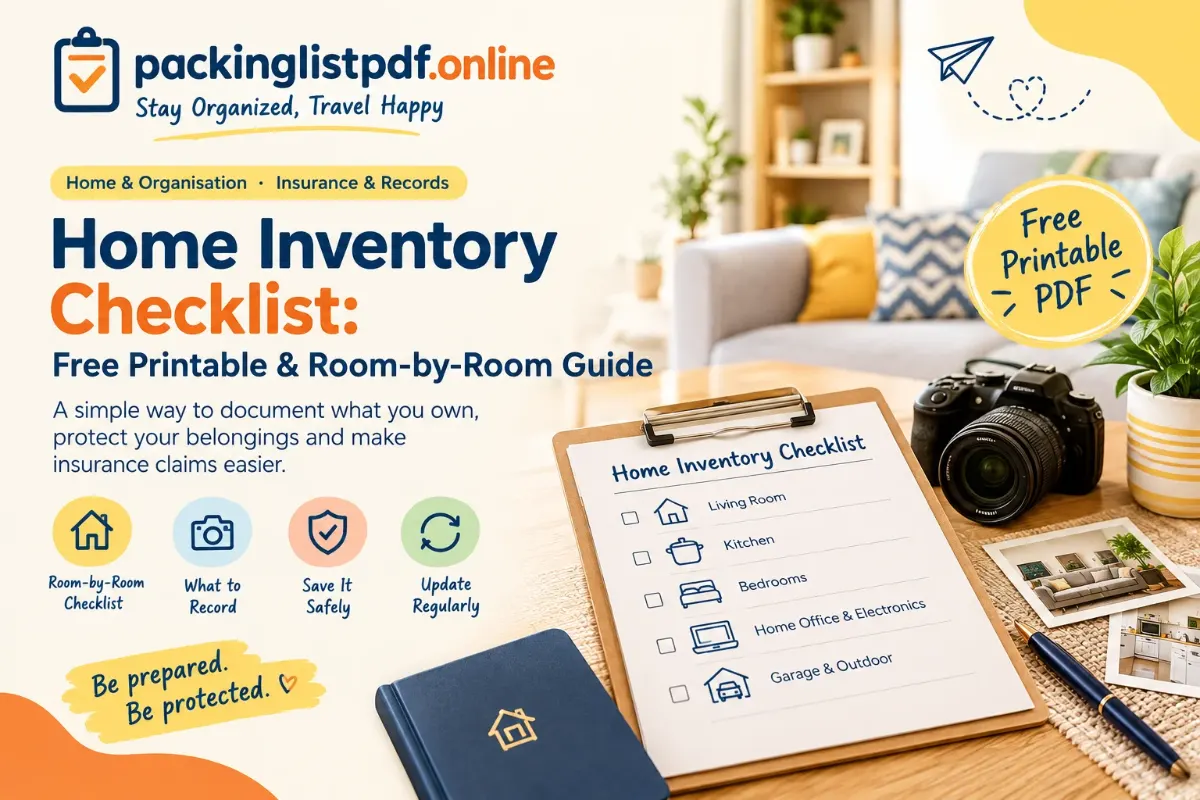
Home Inventory Checklist: Free Printable & Room-by-Room Guide
A home inventory checklist is the single easiest way to make an insurance claim faster and less stressful — it’s just a documented record of what you own, room by room, so you’re not trying to remember everything from memory after a fire, flood, or break-in. This guide walks through exactly what to record, room by room, plus a free printable version.
Skip ahead — get the printable PDF
The full checklist below, formatted for printing or your fridge.
On this page
Custom Home Inventory Checklist Builder
Every item below is pre-checked based on our full guide. Uncheck what doesn’t apply, add your own, then print your personalized list.
Most people only think about a home inventory checklist after something’s already gone wrong — a fire, a burst pipe, a break-in — when it’s too late to walk through the house and remember what was there. Building one now, while everything’s still in place, is what actually makes an insurance claim go smoothly instead of becoming a guessing game.
1. Quick Look: What’s in a Home Inventory Checklist
Step | What It Covers |
|---|---|
Document each room | Furniture, electronics, and valuables, room by room |
Record key details | Photos, receipts, serial numbers, purchase price |
Store it safely | Cloud storage or a second copy outside the home |
Update it regularly | After major purchases or once a year |
Keep reading for the full room-by-room checklist and exactly what to record for each item.
2. What Is a Home Inventory Checklist?
A home inventory checklist is a written or photographed record of everything you own inside your home, organized so you can quickly reference it if you ever need to file an insurance claim. It typically includes a description of each item, its approximate value, and proof like a photo or receipt.
It’s not just for homeowners
Renters need this just as much — your landlord’s insurance covers the building, not your belongings inside it.
3. How to Create a Home Inventory for Insurance
You create a home inventory for insurance purposes by walking through each room, documenting items with photos or video, and noting details like purchase price and receipts as you go, rather than trying to reconstruct it from memory later.
Start with your most valuable rooms first — living room electronics and bedroom jewelry tend to matter most for a claim — then work through the rest of the house at a pace that doesn’t feel overwhelming.
4. What to Record for Each Item
The details that actually matter for insurance are simpler than most people expect — you don’t need an appraisal for everything, just enough documentation to prove ownership and value.
What to Record
Detail | Why It Matters |
|---|---|
Photo or video | Laptop, charger, phone, power bank, headphones |
Purchase receipt | Confirms price paid, useful for reimbursement |
Serial number | Required for electronics on many claims |
Approximate current value | Used to calculate your payout |
Purchase date | Helps account for depreciation, if applicable |
5. Room-by-Room Home Inventory Checklist
Working room by room keeps the process manageable — here’s what to document in each of the five areas that matter most.
🛋️ Living Room
6 items
TV, sound system & streaming devices | |
Sofas, chairs & coffee tables | |
Rugs & curtains | |
Artwork & decor | |
Bookshelves & their contents | |
Gaming consoles & accessories |
Electronics are usually the highest-value items in this room — photograph serial numbers directly.
🍳 Kitchen
6 items
Refrigerator, oven & dishwasher | |
Small appliances (microwave, coffee maker, mixer) | |
Cookware & bakeware sets | |
Dishware & glassware sets | |
Silverware, including any formal sets | |
Table & chairs |
Group smaller items (like dishware) as a set with an estimated total value rather than itemizing every piece.
🛏️ Bedrooms
6 items
Beds, mattresses & frames | |
Dressers & nightstands | |
Jewelry & watches | |
Clothing, especially higher-value items | |
Closet organizers & storage bins | |
Laptops or tablets kept in the room |
Jewelry often needs a separate receipt or appraisal — check your policy’s per-item limit for these.
💻 Home Office & Electronics
6 items
Desktop or laptop computers | |
Monitors, printers & peripherals | |
Cameras & camera equipment | |
Desk, chair & filing cabinets | |
Closet organizers & storage bins | |
External hard drives & backup devices |
This room usually holds the highest total value per square foot — don’t rush through it.
🧰 Garage & Outdoor
5 items
Power tools & hand tools | |
Lawn equipment & mowers | |
Bicycles & sports equipment | |
Patio furniture & grills | |
Storage bins & their general contents |
This is the most commonly skipped room — don’t forget it just because it’s not living space.
6. 3 Easy Ways to Document Your Home Inventory
There’s no single right way to build this — pick whichever method you’ll actually finish, since a partial inventory still beats no inventory at all.
Video Walkthrough
Film a slow walkthrough of every room, narrating what you see and opening drawers or closets as you go.
Spreadsheet
List each item with columns for room, value, and purchase date — best if you like structured, searchable records.
College Dorm Packing Checklist
Take individual photos of higher-value items and organize them into albums by room on your phone or cloud storage.
7. Home Inventory Checklist: Renters vs. Homeowners
The process is nearly identical for both, but what you’re protecting — and which policy covers it — is different.
Renters vs. Homeowners
Detail | Renters | Homeowners |
|---|---|---|
Policy that applies | Renter’s insurance | Homeowner’s insurance |
Structure of the home covered | No — landlord’s policy | Yes |
Personal belongings covered | Yes, with an inventory | Yes, with an inventory |
Inventory still needed | Yes | Yes |
8. Common Mistakes to Avoid
SKIP 01
Not saving receipts
Without proof of purchase, claims take longer.
Instead: photograph or scan receipts as you buy things.
SKIP 02
Skipping storage areas
Garages, attics, and closets get forgotten most.
Instead: include every storage space, not just living areas.
SKIP 03
Never updating it
Beaches, hiking, formal dinners, “just in case” — the result is a heavy bag and the same two outfits worn all trip.
Instead: update it once a year or after big purchases.
SKIP 04
Storing it on one device
A house fire could destroy your only copy too.
Instead: back it up to the cloud or a second location.
Keeping on top of your home is easier with a routine — try our free daily routine checklist for a simple morning-to-night plan.
9. Frequently Asked Questions
Sources: General guidance in this article reflects common recommendations from organizations such as the Insurance Information Institute (iii.org) on documenting belongings for insurance purposes. Always confirm specific documentation requirements with your own insurance provider.
Most Downloaded
The travel checklists readers trust most