The Ultimate Daily Routine Checklist [2026 Printable]
People who follow a written daily routine save an average of 23 minutes every morning and report 47% lower decision fatigue by 10am. No 5am wake-ups required — just real, flexible routines that work for actual humans, plus a free printable checklist.
Skip ahead — get the printable PDF
The full checklist below, formatted for printing or your fridge.
On this page
68% of high-performing adults use some form of daily checklist, and parents with structured routines report 56% fewer morning meltdowns — from kids and from themselves.
This checklist is built from productivity research and real routines used by organized parents and busy professionals. No fluff, no “wake up at 5am and meditate for an hour” — just flexible routines that work for actual humans.
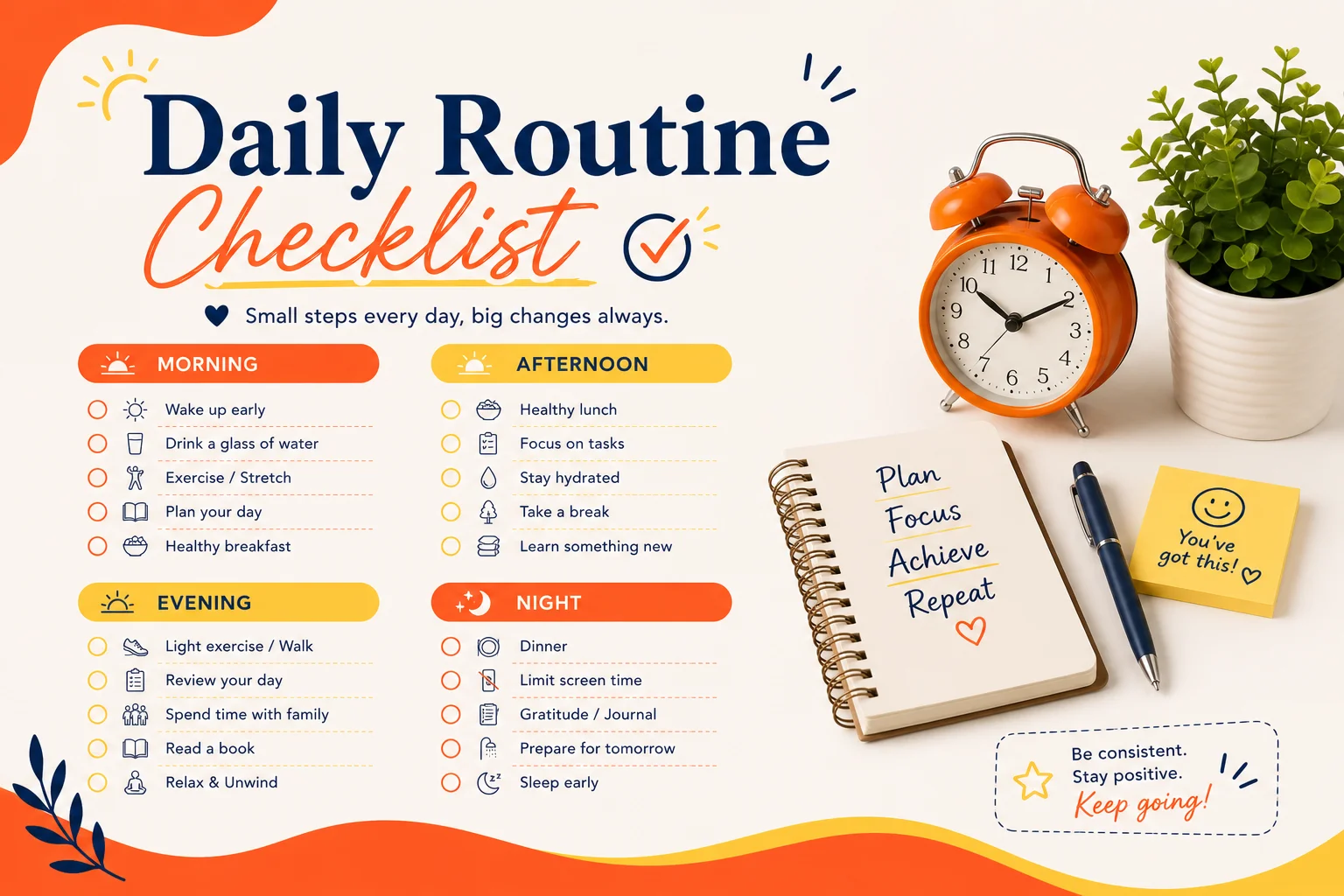
1. Quick Look: The 60-Second Daily Routine Checklist
Keep reading for the full detailed version below — but here’s the whole day at a glance.
| The “Minimum Viable Morning” — 10 minutes, for chaotic days | ||
|---|---|---|
| Task | Time | Done |
| 1. Wake up at the same time (± 30 min) | 1 min | ☐ |
| 2. Drink 1 glass of water | 1 min | ☐ |
| 3. Use the bathroom + brush teeth | 3 min | ☐ |
| 4. Wash face + moisturize + sunscreen | 2 min | ☐ |
| 5. Get dressed (outfit picked the night before) | 2 min | ☐ |
| 6. Make eye contact with yourself in the mirror + say something kind | 1 min | ☐ |
2. Morning Routine (The First Hour Sets the Tone)
You don’t need to wake up at 4:30am. You just need a repeatable process.
| The “Productive Adult Morning” — 30–45 minutes | ||
|---|---|---|
| Task | Time | Done |
| 1. Wake up at your planned time | 2 min | ☐ |
| 2. Drink water and hydrate | 2 min | ☐ |
| 3. Bathroom, brush teeth, and wash face | 5 min | ☐ |
The no-snooze rule
Hitting snooze fragments your sleep and makes you more tired, not less. Set your alarm for the last possible wake-up time — one alarm, and get up.
3. Leaving the House Checklist (The “Did I Forget?” Prevention)
This simple check can save around 47 “I need to turn around” moments a year.
| Before You Walk Out the Door — 30 seconds | |
|---|---|
| ☐ | Item |
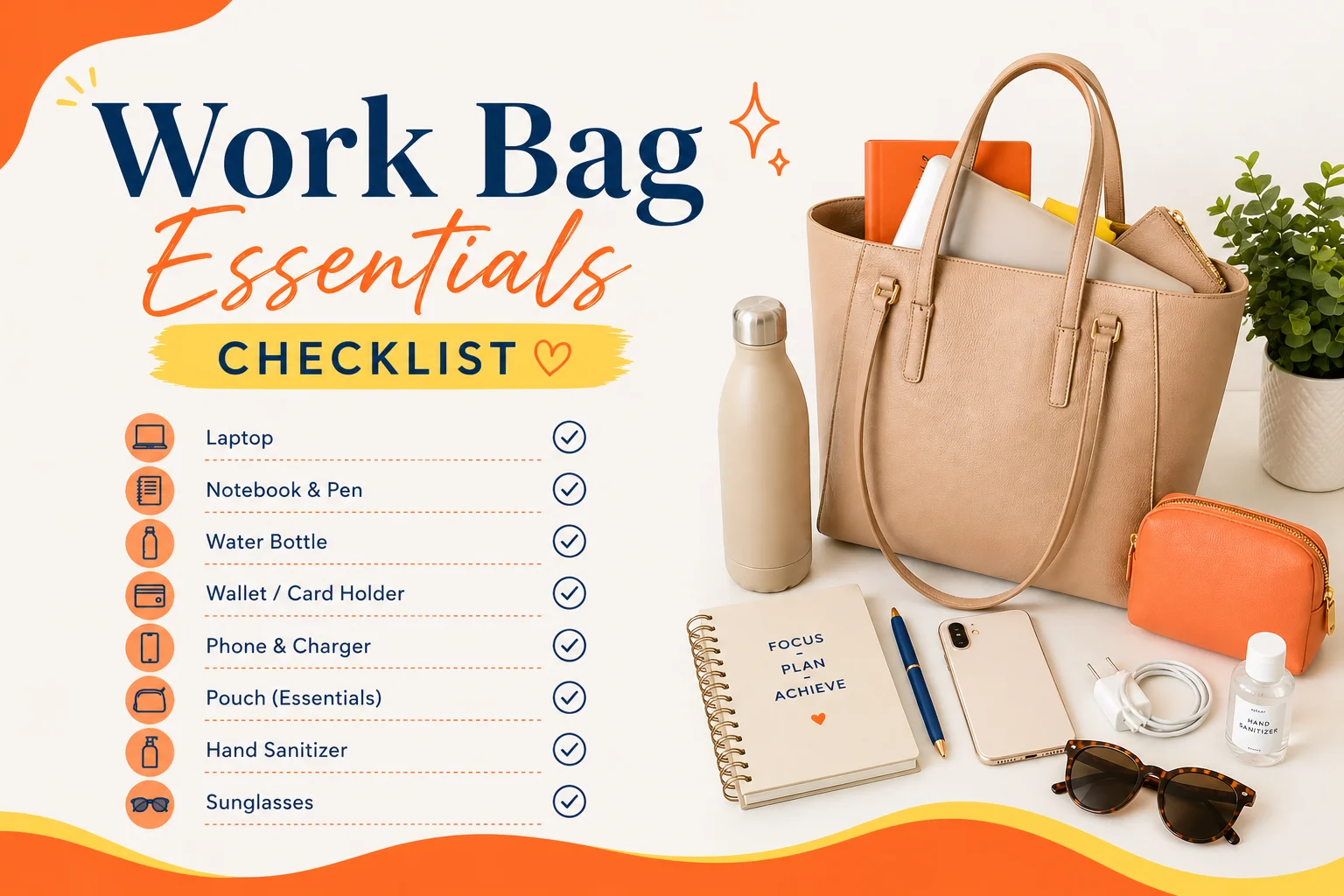
| ☐ | Phone |
| ☐ | Wallet / purse |
| ☐ | Keys |
| ☐ | Work ID / badge |
| ☐ | Water bottle |
| ☐ | Lunch / snacks |
| ☐ | Sunglasses (if sunny) |
| ☐ | Umbrella (if rain is forecast) |
| The “WALLET” Acronym — tap your pockets | |
|---|---|
| Letter | Item |
| W | Water bottle |
| A | AirPods / headphones |
| L | Lunch |
| L | Laptop / work bag |
| E | Eyeglasses / sunglasses |
| T | Phone + charger / power bank |
Keep a “go bag” by the door, year-round
Inside: an umbrella, sunglasses, hand sanitizer, a small first aid kit, a reusable shopping bag, a pen, and a small notebook. Grab-and-go for any outing.
4. Work / School Day Routine (Focus Without Burnout)
| The 3-3-3 Method — for work days | |
|---|---|
| Task | Time |
| 1. Spend 3 hours on your most important project | Deep work |
| 2. Complete 3 smaller urgent tasks | 30–60 min |
| 3. Do 3 maintenance tasks (email, Slack, scheduling) | 30 min |
| The Pomodoro Method — for focus | ||
|---|---|---|
| Cycle | Action | Time |
| 1 | Work | 25 min |
| 2 | Break — stand, stretch, water | 5 min |
| 3 | Repeat 4 times | – |
| 4 | Longer break | 15–30 min |
| Daily Work Checklist | ||
|---|---|---|
| Time | Task | Done |
| Start | Review top 3 priorities for today | ☐ |
| Morning | Complete the hardest task first — “eat the frog” | ☐ |
| 10:30am | Stand up, stretch, refill water | ☐ |
| Lunch | Step away from the screen, eat without working | ☐ |
| Afternoon | Batch similar tasks — all email at once, not constantly | ☐ |
| 3pm | 5-min walk or stretch — the afternoon slump killer | ☐ |
| End | Close tabs, write tomorrow’s top 3, tidy desk | ☐ |
| End | Turn off notifications — don’t check email after hours | ☐ |
The two-minute rule
If a task takes less than 2 minutes, do it immediately. Don’t write it down, don’t schedule it — just do it.
5. Evening Routine (The Secret to Good Mornings)
Your tomorrow morning is created tonight.
| The “Prep for Tomorrow” Evening Checklist — 15 minutes | ||
|---|---|---|
| Task | Time | Done |
| 1. Tidy 1 room — a 5-min pickup | 5 min | ☐ |
| 2. Pack bag for tomorrow | 2 min | ☐ |
| 3. Lay out outfit, including socks + shoes | 2 min | ☐ |
| 4. Prep coffee / tea — set timer or fill kettle | 1 min | ☐ |
| 5. Prep lunch / snacks, put in fridge | 3 min | ☐ |
| 6. Charge phone + laptop + headphones | 1 min | ☐ |
| 7. Write tomorrow’s top 3 priorities | 1 min | ☐ |
| The “Wind Down” Evening Routine — 30–60 minutes before bed | |
|---|---|
| Task | Why |
| 1. Stop eating 2–3 hours before bed | Digestion disrupts sleep |
| 2. Dim lights — use lamps, not overhead | Signals melatonin production |
| 3. Put phone away, no scrolling in bed | Blue light destroys sleep quality |
| 4. Evening hygiene — brush, wash, skincare | Ritual signals bedtime |
| 5. Change into pajamas | Physical cue |
| 6. Read a physical book or Kindle, no backlight | Low stimulation |
| 7. 5 min of deep breathing or stretching | Lowers cortisol |
| 8. In bed by a consistent time (± 30 min) | Circadian rhythm |
The phone-away rule
No phones in the bedroom — period. Get a $10 alarm clock instead. This single change is reported to improve sleep for the vast majority of people who try it.
6. Nighttime Routine (Sleep Hygiene That Works)
| The “Good Sleep” Checklist | ||
|---|---|---|
| ☐ | Task | Why |
| ☐ | Room completely dark | Light suppresses melatonin |
| ☐ | Room cool — 65–68°F / 18–20°C | Body needs a temp drop to sleep |
| ☐ | Quiet — earplugs or a sound machine if needed | Noise fragments sleep |
| ☐ | No caffeine after 2pm | Stays in your system 8+ hours |
| ☐ | No alcohol within 3 hours of bed | Disrupts REM sleep |
| ☐ | Bathroom break right before bed | Prevents a 3am wakeup |
| ☐ | Bedtime within the same 30-min window | Circadian rhythm |
| If You Can’t Sleep — a 10-minute reset | |
|---|---|
| Step | Action |
| 1 | Get out of bed — don’t lie there stressing |
| 2 | Go to another dark room |
| 3 | Read a boring book, no screens |
| 4 | Drink a small amount of water |
| 5 | Deep breathing — 4 sec in, 6 sec out |
| 6 | Return to bed only when drowsy |
The 4-7-8 breathing method
Inhale for 4 seconds, hold for 7, exhale for 8. Repeat 4–8 times. It’s a simple way to lower heart rate and anxiety, and it works within minutes.
7. Weekly Routine (The Bigger Picture)
| The “One Hour Weekly Reset” — Sunday or Friday | ||
|---|---|---|
| # | Task | Time |
| 1 | Review last week — what worked, what didn’t | 10 min |
| 2 | Plan next week’s appointments + events | 10 min |
| 3 | Meal plan for the week, or at least 3 dinners | 15 min |
| 4 | Grocery list from the meal plan | 5 min |
| 5 | Tidy one neglected area — car, purse, desk, fridge | 15 min |
| 6 | Laundry — start a load immediately | 5 min to start |
| 7 | Review budget / pay bills | 10 min |
📅 Do Daily
5 tasks- Make bed
- Tidy 5 minutes
- Dishes
- Check email
- Write tomorrow’s list
Small, consistent, and easy to keep up with.
🗓️ Do Weekly
5 tasks- Wash sheets
- Deep clean one room
- Clean out the fridge
- Meal prep
- Review budget
Don’t confuse these with the daily list — batching them weekly saves real time.
8. The “But What About…” Category
Standard routines don’t fit every schedule or every brain. Here’s how to adapt.
Shift Workers / Non-9-to-5
Inconsistent sleep: prioritize a dark room, cool temp, and earplugs regardless of the hour.
Shifting mealtimes: keep the same eating order — breakfast, lunch, dinner — even if it’s at 3pm.
30-min wind-down buffer post-shift helps most.
ADHD / Executive Function
Visible checklists: on the fridge, not buried in your phone.
5-min timer trick: tell yourself “just 5 minutes” — you’ll often keep going.
Externalize everything. Reward after tasks, not before.
Depression / Low-Motivation Days
The minimal viable routine is just 3 things: brush teeth, drink water, change out of pajamas.
On hard days, surviving is succeeding — this checklist is a tool, not a judge.
A gentle note
This checklist is a planning tool, not medical advice. If low motivation or low mood lasts more than two weeks, it can help to talk it through with a doctor or therapist.
9. The “Do Not Do” List (Routine Killers)
Checking your phone on waking
Trains your brain to react instead of lead.
Instead: drink water first, phone later.
The snooze button
Fragments sleep and increases tiredness.
Instead: one alarm, last possible time.
Working from bed
Your brain needs location cues to switch modes.
Instead: a desk, a chair, anywhere but bed.
“I’ll remember that”
You won’t — and it adds mental clutter all day.
Instead: write it down immediately.
Skipping breakfast twice in a row
Sets up a blood sugar crash by 10am.
Instead: even something small counts.
No buffer between tasks
Back-to-back meetings lead straight to burnout.
Instead: 5–10 min breathing room.
Perfectionism
Waiting for the “perfect” routine to start.
Instead: a routine done at 70% beats no routine.
Keeping this free
Use a notebook you already own, your phone’s built-in timer and alarm, free printable checklist templates, and tap water — no new purchases required.
10. The Emergency Low-Spoon Routine
For when life falls apart. Do only these — everything else can wait.
🌅 Morning — 3 things
5 items
Drink water | ||
Brush teeth | ||
Change clothes |
That’s it. That’s the whole morning.
🌙 Evening — 3 things
3 items
Eat something | ||
Phone on charger | ||
Bed by midnight |
You’re still succeeding.
11. Frequently Asked Questions
Most Downloaded
The travel checklists readers trust most