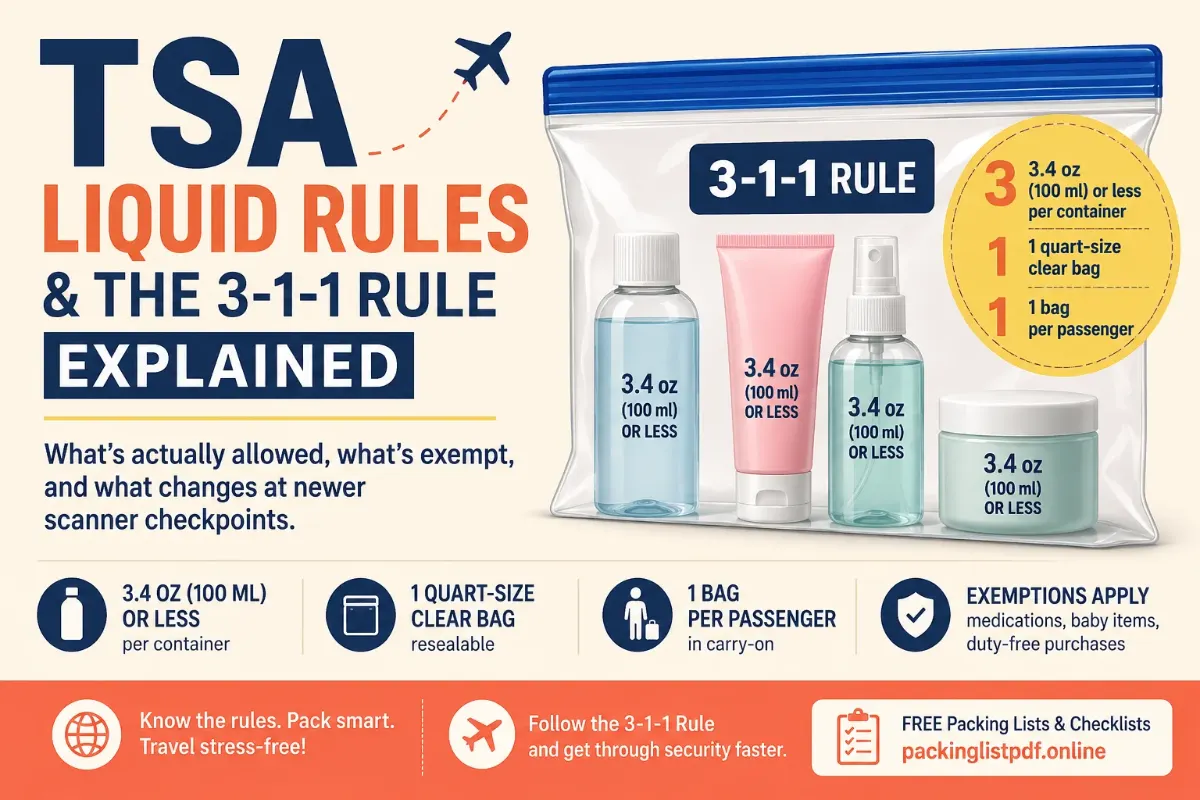
TSA Liquid Rules & the 3-1-1 Rule Explained
What’s actually allowed, what’s exempt, and what changes at newer scanner checkpoints.
Liquids are the single most common reason items get pulled or confiscated at airport security, usually because the container was slightly over the limit or wasn’t in the right kind of bag. The TSA liquid rules — known as the 3-1-1 rule — are what govern this, and once you understand the three numbers behind it, packing liquids stops being a guessing game.
Quick Answer
The TSA 3-1-1 rule means each liquid container must be 3.4 oz (100 ml) or less, all containers must fit in one quart-size clear resealable bag, and each passenger is allowed one such bag. Medications, baby food, and duty-free purchases are exempt if declared.
TSA Liquid Rules & the 3-1-1 Rule: Quick Overview
The TSA 3-1-1 rule limits how much liquid, gel, aerosol, cream, or paste you can bring in a carry-on bag, capping each container at 3.4 ounces and requiring all of them to fit in a single quart-size bag. It’s been the standard at U.S. airport security checkpoints since 2006, introduced after a foiled plot to bring liquid explosives onto flights. As of 2026, the core rule is still the nationwide baseline — the only thing shifting is how it’s enforced at airports with newer scanning technology.
What Counts as a “Liquid” Under TSA Rules
TSA treats anything pourable, spreadable, sprayable, or squeezable as a liquid, which catches a lot of everyday items people don’t expect.
Shampoo, conditioner, and body wash | |
Toothpaste and lotion | |
Contact lens solution | |
Perfume and cologne | |
Peanut butter, yogurt, and sauces (yes, really) | |
Deodorant, if it’s a gel or spray |
Solid deodorant, soap bars, and solid shampoo bars are not liquids and skip this limit entirely.
What’s Exempt from the 3-1-1 Rule
Several categories of liquids are allowed in larger quantities, as long as you declare them to a TSA officer at the checkpoint for extra screening.
Medications — liquid, gel, or aerosol medications in reasonable trip quantities, in original packaging when possible | |
Baby and infant items — baby food, formula, and breast milk over 3.4 oz, even without a baby traveling with you | |
Duty-free purchases — alcohol or perfume bought within 48 hours, sealed in a tamper-evident bag with the receipt visible | |
Medically necessary liquids — over 3.4 oz for conditions that require them, declared separately at the checkpoint |
How to Pack Your Quart-Size Bag
Packing the bag correctly is what actually speeds you through the checkpoint, more than anything about the liquids themselves.
Use one clear, quart-size, resealable bag — not a larger gallon bag | |
Every container inside must be 3.4 oz or smaller, even if it’s not full | |
Pack the bag near the top of your carry-on for easy access | |
Keep it separate from other liquids you’re not planning to bring through security | |
Leave a little room so the bag actually zips or seals flat |
New CT Scanners: What’s Changing at Some Airports
Some airports now use advanced CT scanners that create a detailed 3D image of your bag, which can mean you don’t need to pull liquids out of your carry-on at that specific checkpoint. This isn’t nationwide yet — where CT scanners are installed, screening can be smoother, but the 3.4 oz container limit still applies. It’s the removal step that sometimes changes, not the size rule itself.
Since coverage varies by airport and even by checkpoint lane, the safest approach is to still pack a compliant quart bag every time and let the TSA officer at your specific lane tell you if removal isn’t needed.
TSA Liquid Rules: Carry-On vs. Checked Bags
The 3-1-1 rule only applies to carry-on bags — checked luggage has essentially no liquid size limit, which is the easiest fix for anyone bringing full-size toiletries.
Rule | Carry-On | Checked Bag |
|---|---|---|
Container size limit | 3.4 oz (100 ml) max | No TSA size limit |
Quart bag required | Yes | No |
Full-size shampoo, etc. | Not allowed | Allowed |
Alcohol content limit | Follows 3-1-1 | Under 70% ABV, sealed |
If you’re bringing full-size toiletries, the simplest move is just to pack them in a checked bag instead of trying to decant everything into travel sizes.
Common Mistakes That Get Liquids Confiscated
Using a gallon-size bag.
Fix: only quart-size bags meet the requirement.
Packing a “mostly empty” big bottle.
Fix: container size counts, not how full it is — decant into 3.4 oz or smaller.
Forgetting food counts as liquid.
Fix: peanut butter, hummus, and sauces are liquids — pack these in checked luggage.
Not declaring medical liquids.
Fix: tell the TSA officer about over-limit medical items before screening starts.
Frequently Asked Questions
Q. What is the TSA 3-1-1 rule?
It’s the TSA rule limiting carry-on liquids to containers of 3.4 oz (100 ml) or less, all packed in one quart-size, clear, resealable bag per passenger.
Q. What is the TSA liquid limit in ounces?
Each container is capped at 3.4 ounces (100 ml), regardless of how much liquid is actually inside it.
Q. What size bag do I need for TSA liquids?
A single quart-size, clear, resealable plastic bag — one per passenger, not one per person’s belongings.
Q. Can I bring more than one quart bag of liquids?
No — TSA allows one quart-size bag per passenger, though exempt items like medication or baby formula don’t count toward that bag.
Q. What liquids are exempt from the 3-1-1 rule?
Medications, baby food, formula, and breast milk, and sealed duty-free purchases with a receipt are all exempt from the standard limit.
Q. Do I still need to take liquids out of my bag at the airport?
At most airports, yes. Some checkpoints with newer CT scanners may not require it, but the 3.4 oz limit still applies either way.
Want a printable version to pack alongside your liquids? Download our free Free Packing List PDF, or check out our Editable Packing List Template if you’d rather customize your own carry-on checklist.