What Can You Bring in a Carry-On Bag? Full List
The TSA-approved list of what’s allowed, what’s not, and the 3-1-1 liquid rule explained in plain English.
You can bring most personal items, electronics, snacks, and toiletries in a carry-on bag — as long as liquids stay under 3.4 oz (100 ml) each and fit in one quart-sized bag, and you avoid a short list of banned items like sharp tools and self-defense sprays. This guide covers exactly what you can bring in a carry-on bag, what’s off-limits, and the TSA rules that trip people up most.
Before you keep reading — if you’re also planning the rest of your trip, our travel packing lists hub has a checklist for almost every trip type.
Official source, plain English. Everything below is based on current TSA guidance. Rules can change without much notice, so always check tsa.gov before a trip if you’re unsure about a specific item.
What Can You Bring in a Carry-On Bag? (Quick Answer)
Almost everything you’d normally pack for a short trip is allowed in a carry-on — clothing, shoes, electronics, books, toiletries under the liquid limit, snacks, and most medications. The items that get flagged at security almost always fall into one of three buckets: liquids over the limit, sharp objects, or anything the TSA classifies as a weapon (even a toy one).
Clothing, shoes, and accessories — no limit
Laptops, tablets, phones, cameras, and chargers
Headphones and portable power banks (under the size limit — see below)
Books, magazines, and travel documents
Toiletries and liquids under 3.4 oz (100 ml) each
Solid food, snacks, and empty water bottles
Baby items, including formula, breast milk, and baby food in reasonable quantities
Most prescription and over-the-counter medications
TSA Liquid Rules: The 3-1-1 Rule Explained
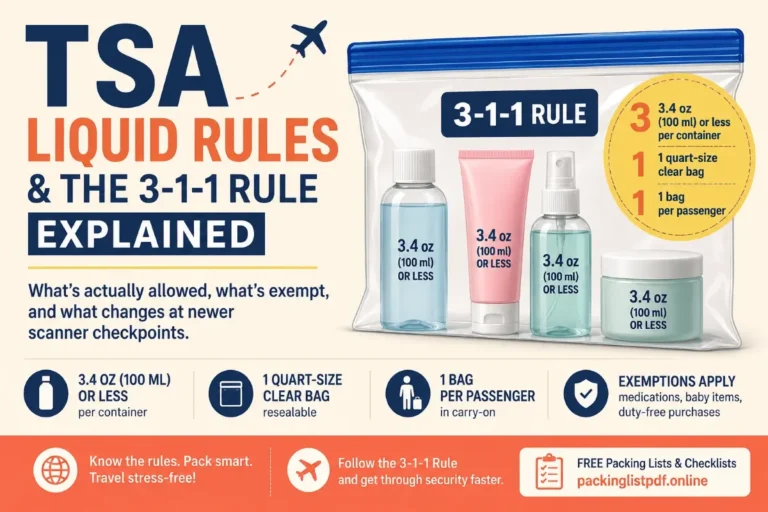
The 3-1-1 rule means each liquid container must hold 3.4 oz (100 ml) or less, all your containers must fit in a single 1-quart clear bag, and each passenger gets 1 bag. This applies to anything that pours, sprays, spreads, or is under pressure — so it covers more than just shampoo and water bottles.
Item | Carry-On Limit | Notes |
|---|---|---|
Liquid, gel, or aerosol container | 3.4 oz (100 ml) max | Even a mostly-empty large bottle is not allowed |
Quart-sized clear bag | 1 per passenger | Must be able to close/zip flat |
Medically necessary liquids | Over 3.4 oz allowed | Declare separately at screening |
Duty-free liquids | Allowed over 3.4 oz | Must stay in a sealed, tamper-evident bag with receipt visible |
Toothpaste, contact lens solution, sunscreen, peanut butter, and even snow globes all count as “liquid or gel” under this rule — so it’s worth checking anything that isn’t solid before you pack it.
Electronics and Power Banks in Your Carry-On
Laptops, tablets, phones, and cameras are all allowed in carry-on bags, but they generally need to come out of your bag and go through screening separately — unless you’re using a checkpoint with newer CT scanners that allow laptops to stay packed.
Power Bank Rules
Portable power banks and spare lithium batteries must travel in your carry-on, not checked luggage, because of fire risk. Most airlines cap power banks at 100Wh without approval, and some allow up to 160Wh with airline permission — anything larger typically isn’t allowed on the plane at all.
Carry-On Bag Size Limits by Airline
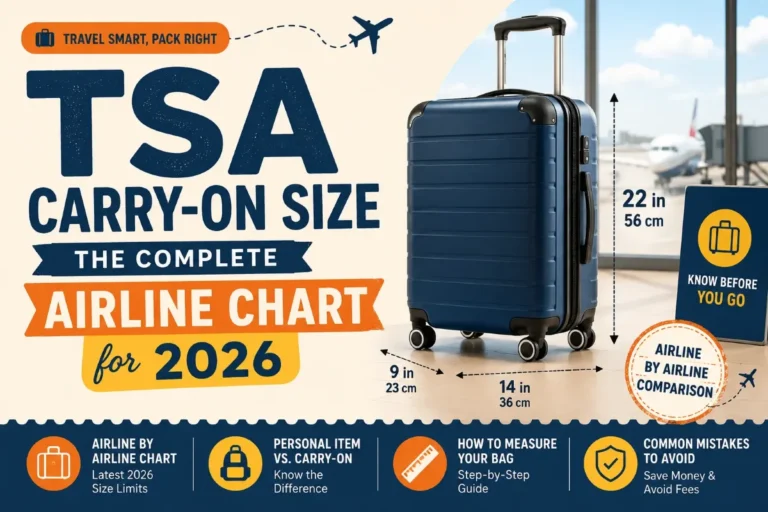
Carry-on size limits vary by airline, so it’s worth checking your specific carrier before you pack — a bag that’s fine on one airline can get gate-checked on another.
Airline | Carry-On Limit | Notes |
|---|---|---|
Liquid, gel, or aerosol container | 3.4 oz (100 ml) max | Even a mostly-empty large bottle is not allowed |
Quart-sized clear bag | 1 per passenger | Must be able to close/zip flat |
Medically necessary liquids | Over 3.4 oz allowed | Declare separately at screening |
Duty-free liquids | Allowed over 3.4 oz | Must stay in a sealed, tamper-evident bag with receipt visible |
Toothpaste, contact lens solution, sunscreen, peanut butter, and even snow globes all count as “liquid or gel” under this rule — so it’s worth checking anything that isn’t solid before you pack it.
Electronics and Power Banks in Your Carry-On
Laptops, tablets, phones, and cameras are all allowed in carry-on bags, but they generally need to come out of your bag and go through screening separately — unless you’re using a checkpoint with newer CT scanners that allow laptops to stay packed.
Power Bank Rules
Portable power banks and spare lithium batteries must travel in your carry-on, not checked luggage, because of fire risk. Most airlines cap power banks at 100Wh without approval, and some allow up to 160Wh with airline permission — anything larger typically isn’t allowed on the plane at all.
Carry-On Bag Size Limits by Airline
Carry-on size limits vary by airline, so it’s worth checking your specific carrier before you pack — a bag that’s fine on one airline can get gate-checked on another.
Airline | Max Carry-On Size (in) | Personal Item Allowed |
|---|---|---|
Delta | 22 x 14 x 9 | Yes |
American Airlines | 22 x 14 x 9 | Yes |
United | 22 x 14 x 9 | Yes |
Southwest | 24 x 16 x 10 | Yes |
Spirit / Frontier (basic fare) | Personal item only, fee for carry-on | Yes (free) |
These are the standard published limits — always check your fare class before flying, since budget airlines especially tend to charge extra for a full-size carry-on even when a personal item is included free.
Food Allowed in a Carry-On
Solid food is allowed in a carry-on with no real restrictions — sandwiches, dry snacks, fruit, and sealed packaged food all pass through security without issue. The 3-1-1 liquid rule only kicks in for food items that are liquid, gel, or spreadable, like sauces, dips, jam, or soup.
Solid snacks (chips, granola bars, dried fruit, sandwiches) — always fine
Peanut butter, jam, hummus, yogurt — treated as liquid/gel, 3.4 oz limit applies
Baby food and formula — allowed in reasonable quantities beyond 3.4 oz, just declare it
Cakes and pies — usually fine, but officers may ask for extra screening
Medication in Your Carry-On
Prescription and over-the-counter medications, including liquids and pills, are allowed in a carry-on and are not subject to the 3.4 oz limit as long as you declare them at the checkpoint. It’s worth keeping medication in original labeled packaging where possible, especially for international travel, since some countries have stricter rules on controlled substances than the US does.
If you’re flying with TSA PreCheck, most of these liquid and medication rules still apply — PreCheck speeds up the screening line and lets you leave shoes and laptops in your bag, but it doesn’t change what you’re allowed to pack. Anyone unsure about a specific prescription, especially controlled substances, should check the guidance for their destination country a few days ahead rather than at the gate.
Traveling with kids adds a few extra allowances too — baby food, breast milk, and formula are all permitted in carry-on quantities beyond the standard 3.4 oz limit, and gel-filled teething items are treated the same way as medically necessary liquids.
For business travelers packing light, it’s also worth reviewing our business trip packing list, which covers how to fit a full work trip into carry-on-only luggage.
Items Not Allowed in a Carry-On Bag
The most commonly confiscated carry-on items are things people don’t think of as weapons — full-size scissors, corkscrews, and self-defense sprays are the repeat offenders, alongside liquids over the 3.4 oz limit.
Sharp objects — knives, box cutters, scissors with blades over 4 inches
Self-defense items — pepper spray, stun guns, mace
Tools over 7 inches — hammers, drills, saws
Sporting goods with swing/impact potential — bats, golf clubs, hockey sticks
Liquids, gels, or aerosols over 3.4 oz that aren’t medically necessary
Large power banks (typically over 160Wh) and damaged lithium batteries
Full Carry-On Packing Checklist
Use this as a final pass before you zip your bag — it covers the categories most travelers actually forget or get wrong at security.
Quart-sized clear bag with liquids under 3.4 oz each
Laptop and tablet accessible for separate screening
Power bank packed in carry-on, not checked luggage
Medications in original packaging, declared if over the liquid limit
Travel documents (ID, boarding pass, any required visas)
Phone charger, headphones, and a spare charging cable
Snacks that are solid, not spreadable or liquid
No sharp tools, self-defense items, or oversized batteries
If you’re packing for a longer international trip, our international travel packing list covers everything beyond the carry-on too — documents, money, and health items included.
Common Mistakes to Avoid
SKIP 01
Packing a “mostly empty” large bottle.
Container size is what’s checked, not how full it is. A 12 oz bottle with a teaspoon of shampoo left still gets tossed.
SKIP 02
Forgetting the power bank is in your checked bag.
Lithium batteries in checked luggage can get your whole bag pulled for inspection — or confiscated. Keep it in your carry-on.
SKIP 03
Assuming duty-free liquids are exempt.
They’re only allowed over 3.4 oz if they stay sealed in the tamper-evident bag with your receipt — opened or repacked, they get confiscated.
SKIP 04
Not declaring medically necessary liquids.
Medication, baby formula, and similar items are allowed over the limit, but only if you tell the officer before screening, not after.
Frequently Asked Questions
Q. What is allowed in a carry-on bag?
Clothing, electronics, books, most medications, solid food, and liquids under 3.4 oz per container are all allowed in a carry-on bag, along with everyday personal items.
Q. What is the 3-1-1 liquid rule for carry-on bags?
The 3-1-1 rule limits each liquid container to 3.4 oz (100 ml), requires all containers to fit in one quart-sized clear bag, and allows one such bag per passenger.
Q. Can you bring a power bank in a carry-on bag?
Yes — power banks must travel in carry-on luggage, not checked bags, and are generally capped at 100Wh without airline approval, or up to 160Wh with permission.
Q. Can you bring food in a carry-on bag?
Solid food like snacks, sandwiches, and fruit is allowed without restriction, while liquid or spreadable food such as sauces and dips counts toward the 3.4 oz liquid limit.s.
Q. Do liquid medications count toward the 3-1-1 rule?
No — medically necessary liquids, including medication and baby formula, are allowed over 3.4 oz as long as you declare them separately at the security checkpoint.
Q. What items are not allowed in a carry-on bag?
Sharp objects like knives and full-size scissors, self-defense items like pepper spray, tools over 7 inches, and liquids over 3.4 oz that aren’t medically necessary are not allowed.
Sources
This guide is based on current guidance from the Transportation Security Administration (tsa.gov) and the Federal Aviation Administration (faa.gov). Rules on specific items — especially lithium batteries and self-defense sprays — can vary slightly by airline, so it’s worth double-checking with your carrier for anything unusual.