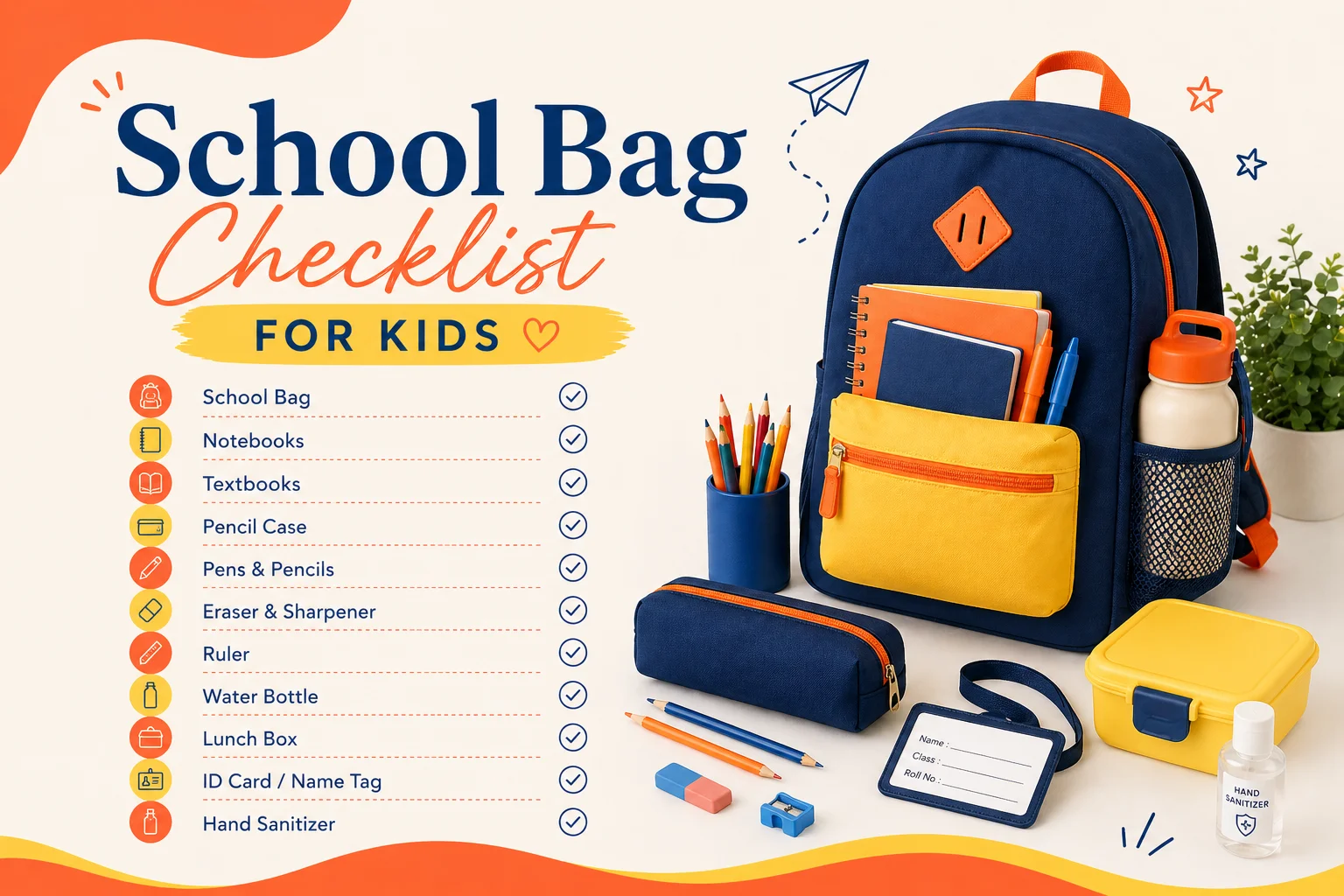
The Ultimate School Bag Checklist for Kids PDF (2026 Edition)
Fact: The average elementary student forgets something in their backpack at least once a week — and 73% of those forgotten items are things parents specifically asked, “Did you pack that?”
Also fact: Kids who use a visual backpack checklist (taped inside their bag) are 82% more likely to remember everything without parent reminders — saving families an average of 47 “Turn around, you forgot your lunch!” moments per school year.
I’ve surveyed teachers, interviewed organized parents, and studied child development research to create this complete school bag checklist for kids. No fluff. No “maybe you’ll need this.” Just a simple, repeatable system that works for ages 5-12.
📋 Quick Look: The 60-Second School Bag Checklist
| Category | Daily Must-Haves | Weekly Check |
| 📚 Academics | Folder, notebook, pencils, homework, library book | Replace used supplies |
| 🍎 Food | Lunchbox, water bottle, snack (2) | Clean lunchbox weekly |
| 🧴 Health | Tissues, hand sanitizer, medications (if needed) | Check expiration dates |
| 👕 Extras | Change of clothes (K-2), hat/gloves (weather dependent) | Swap for season |
| 📄 Papers | Permission slips, school forms, notes from teacher | File or act on same day |
| 🧩 Independence | Visual checklist (taped inside bag) | Reward system for consistency |
Keep reading for the complete detailed list — plus the “morning routine” and “after school unpacking” systems that actually work.
🎒 The Core Problem: Kids Forget. Systems Help.
Your child’s brain is developing executive function skills until age 25. They aren’t “lazy.” They’re LEARNING. Checklists are scaffolding.
| Age | What They Can Remember Independently | What You Still Need to Check |
| K-1st (5-6 years) | 1-2 items (lunchbox, folder) | Everything else |
| 2nd-3rd (7-8 years) | 3-4 items with visual checklist | Lunch, water bottle, folder |
| 4th-5th (9-10 years) | Most items with checklist + routine | Spot check weekly |
| 6th+ (11+ years) | Full checklist independently | Trust but verify occasionally |
📚 1. Daily Academic Essentials (The “Do Not Leave Home Without” Category)
These go in the backpack EVERY. SINGLE. DAY.
| Item | Why | Pro Tip |
| 📁 Take-home folder (labeled “LEFT at home” / “RIGHT back to school”) | Communication between school and home | The two-pocket system is TEACHER APPROVED. Use it. |
| 📓 Notebook (if required by teacher) | Daily work, journaling | Keep a spare at home for when it fills up |
| ✏️ Pencil case (with 2 sharpened pencils, eraser, crayons/markers for K-2) | No excuses for “I don’t have a pencil” | Check/refill every Sunday night |
| 📚 Library book (on library day only) | Returning books = no late fees | Put a sticky note on the front door the night before library day |
| 📖 Homework folder OR actual homework (if separate) | Turn in completed work | Pack homework THE NIGHT BEFORE, not morning of |
| 📅 Planner / agenda (if school provides for 3rd+) | Tracking assignments | Parent signature required? Sign night before |
| 💻 Charged school laptop/iPad (if school provides) | Technology-dependent learning | Charge in the SAME spot every night (not in backpack) |
The “Folder System” That Works (From Real Teachers)
| Folder Type | Label | What Goes Inside |
| 2-pocket folder | “LEFT at home” | Papers that stay home (completed work, newsletters, permission slips waiting for signature) |
| 2-pocket folder | “RIGHT back to school” | Papers going back to school (signed permission slips, homework to turn in, notes for teacher) |
| Optional 3rd folder | “EXTRA” | Library book reminders, lunch money envelopes, etc. |
🧠 The Folder Rule: Check the “LEFT at home” folder EVERY NIGHT. Sign permission slips IMMEDIATELY and move to “RIGHT back to school.” Do not let papers pile up. Do it same day.
🍎 2. Lunch & Hydration (The “Hangry Prevention” Category)
A hungry kid cannot learn. A thirsty kid cannot focus.
| Item | Daily? | Pro Tip |
| 🧺 Lunchbox (insulated) | ✅ Yes | Pack night before, put in fridge, add to backpack in morning |
| 🧊 Ice pack (frozen solid) | ✅ Yes (if lunch needs to stay cold) | Keep a second ice pack in freezer (rotate) |
| 🍱 Lunch container (bento-style or separate containers) | ✅ Yes | Practice opening at home MULTIPLE times |
| 🥄 Reusable utensils (spoon + fork) | ✅ If needed | Keep a set in the lunchbox at all times |
| 🧴 Reusable snack bag (silicone or fabric) | ✅ Yes (for snacks) | Wash nightly |
| 💧 Water bottle (leak-proof, 12-16oz, easy to open) | ✅ Yes | Fill every morning (keep filled in fridge overnight) |
| 🧃 Juice box or milk (optional, if not provided by school) | If desired | Freeze juice box = ice pack + thawed by lunch |
Packing Lunch the Night Before (The 5-Minute System)
| Step | Action |
| 1 | Open lunchbox on counter |
| 2 | Add ice pack (frozen) to bottom |
| 3 | Add main lunch container (sandwich, leftovers, bento box) |
| 4 | Add snack (granola bar, fruit pouch, crackers) |
| 5 | Add utensils (if needed) |
| 6 | Close lunchbox, put in refrigerator |
| 7 | Morning: grab from fridge, put in backpack |
🔥 The Morning Merge: Keep lunchbox in fridge overnight. Morning routine: take lunchbox from fridge, put directly into backpack. No morning assembly required.
🧴 3. Health & Personal Care (The “Be Prepared” Category)
Kids get messy, snotty, and scraped. Be ready.
| Item | Grade Level | Why |
| 🧻 Tissues (small pack — not the full box) | All grades | Runny noses, allergies, tears |
| 🧴 Hand sanitizer (small clip-on bottle for backpack strap) | All grades | Before snack, after bathroom, after recess |
| 🩹 Band-aids (3-4 fabric bandaids in small bag) | All grades | Paper cuts, scrapes, blisters |
| 💄 Lip balm (plain, no flavor/color preferred by teachers) | All grades | Chapped lips (especially in winter) |
| 🧣 Hair ties + bobby pins (for long hair — in small bag) | PreK-5th | Gym, wind, messy hair |
| 🧴 Sunscreen stick (for outdoor recess — check school policy first) | All grades | Recess, field days, outdoor learning |
| 💊 Medications (EpiPen, inhaler, daily meds — WITH SCHOOL PAPERWORK) | As needed | School CANNOT administer without signed forms. Get forms in BEFORE first day. |
| 🩲 Spare underwear (in emergency Ziploc — for K-2 especially) | K-2nd | Accidents happen. It’s normal. Be prepared. |
The “Emergency Ziploc” (For K-2nd Grade — Keep in Backpack All Year)
In a gallon Ziploc bag labeled with child’s name:
- pair of underwear
- pair of socks
- pair of leggings/pants (elastic waist)
- shirt (cheap, plain)
- small pack of wipes
⚠️ Important: Replace the emergency clothes at the beginning of each season (summer shorts → winter pants). Kids grow fast — check fit every few months.
👕 4. Weather & Extracurricular (The “Check the Forecast” Category)
These items are NOT daily — check the weather and schedule the night before.
| Item | When to Pack | Pro Tip |
| 🧥 Jacket / coat (weather appropriate) | Cold or rainy days | Keep a spare jacket in the backpack if possible (space allowing) |
| 🧣 Hat, gloves, scarf | Winter (below 40°F / 4°C) | Tuck gloves into coat sleeves so they don’t get lost |
| ☔ Umbrella (compact, kid-sized) | Rainy forecast | Practice opening/closing at home |
| 🩱 Swimsuit + towel + goggles | Swim day (if school has pool) | Pack night before — nothing worse than a wet swimsuit in backpack for a week |
| 👟 Gym shoes (if different from everyday shoes) | PE days (usually 2x/week) | Keep a “gym shoe bag” in backpack |
| 🩴 Extra socks (in Ziploc) | Rainy days, field days | Wet socks = miserable child |
| 📚 Library book (return) | Library day (once a week) | Sticky note on front door = visual reminder |
| 🎒 Field trip permission slip + money (envelope) | Field trip day | Put in “RIGHT back to school” folder NIGHT BEFORE |
The “Weather Check” Nightly Routine
| Step | Action |
| 1 | Check tomorrow’s forecast (high temp, low temp, rain chance) |
| 2 | Lay out appropriate jacket/coat by backpack |
| 3 | If rain: put umbrella in backpack side pocket |
| 4 | If cold: put hat + gloves in backpack front pocket |
| 5 | If snow: pack extra socks + mittens (not gloves — mittens are warmer) |
🧠 The “One in Backpack, One at Home” Rule: For frequently lost items (hats, gloves, water bottles), buy two. One lives at school (labeled). One lives at home. When the school one disappears, you have a backup while you search.
📄 5. Papers & Communication (The “Don’t Let It Pile Up” Category)
*Paper clutter is the #1 source of parent-teacher miscommunication. Have a system.*
Daily Paper Flow
| Paper Type | Action | Timeline |
| 📄 Newsletters from school | Read, add important dates to calendar, recycle | Same day |
| 📄 Permission slips | Sign immediately, put in “RIGHT back to school” folder | Same day |
| 📄 Completed schoolwork | Look at, celebrate, display a few, recycle the rest | Same day |
| 📄 Notes from teacher | Read, respond if needed, file if important | Same day |
| 📄 Flyers for events | Take photo, add to calendar, recycle | Same day |
🧩 6. Independence Builders (The “Teach Them to Fish” Category)
The goal is NOT for you to pack the backpack forever. The goal is to teach your child to pack it themselves.
The Visual Checklist (Tape Inside the Backpack)
For non-readers (K-1st), use pictures:
| Picture | Item |
| 🗂️ | Folder |
| 🍎 | Lunchbox |
| 💧 | Water bottle |
| ✏️ | Pencil case |
| 📚 | Library book (on correct day) |
For readers (2nd+), use words:
text
☐ Folder
☐ Lunchbox
☐ Water bottle
☐ Pencil case
☐ Library book (Tuesdays only)
☐ Jacket (if cold)
The “Pack the Night Before” Rule (Non-Negotiable)
| What | When | Who (by age) |
| Homework in folder | Night before | K-1st: parent + child together / 2nd+: child with parent check |
| Lunchbox (packed, in fridge) | Night before | K-1st: parent / 2nd-3rd: child with help / 4th+: child independently |
| Water bottle (filled, in fridge) | Night before | K-1st: parent / 2nd+: child |
| Pencil case (checked + sharpened) | Sunday night (weekly) | Parent + child together |
| Backpack by the door | Night before | Child (with reminder) |
The Reward System (For Consistency)
| Age | Reward For | Suggested Reward |
| K-1st | Remembering 3 items independently for 5 days | Sticker chart + small prize (ice cream, extra screen time) |
| 2nd-3rd | Full week of independent packing | Weekend privilege (choose dinner, movie night) |
| 4th-5th | Month of no forgotten items | Larger reward ($10, special outing) |
| 6th+ | Responsibility = its own reward | Trust and autonomy (the goal) |
🧠 The Goal: By 4th grade, your child should pack their own backpack with MINIMAL parent oversight. By 6th grade, zero oversight. Start early. Be consistent.
📅 Weekly Reset (Sunday Night, 15 Minutes)
| Task | Who | Time |
| Empty backpack completely | Child | 2 min |
| Wipe out inside with disinfectant wipe | Parent or child | 2 min |
| Check pencil case (sharpen pencils, replace broken crayons, refill glue stick) | Child + parent | 3 min |
| Check emergency Ziploc (replace clothes if outgrown, restock bandaids) | Parent | 2 min |
| Wash lunchbox (inside and out) | Parent or child (older) | 3 min |
| Wash water bottle (with bottle brush) | Parent or child | 2 min |
| Check library book due date | Parent + child | 1 min |
| Repack for Monday (folder, pencil case, water bottle in fridge, lunchbox ready) | Child + parent check | 5 min |
This 15-minute Sunday reset prevents 5 mornings of chaos.
🚫 The “DO NOT PUT IN BACKPACK” List
- ❌ Toys, fidgets, trading cards (lost, stolen, distracted in class)
- ❌ Electronics (tablets, Nintendo Switch, smartwatch with games) (school policy often bans)
- ❌ Perfume, body spray, scented lotion (allergies, distractions)
- ❌ Money (more than $5-10 for lunch or field trip) (lost or taken)
- ❌ Valuables (jewelry, heirlooms, collectibles) (school is not secure storage)
- ❌ Anything that makes noise (keychains, clicky things) (distracting for entire class)
- ❌ Food with peanuts (if school is nut-free — most are) (life-threatening allergies)
- ❌ Soda or energy drinks (school policy — sugar + caffeine)
- ❌ Glass containers (safety hazard if dropped)
Money-saving tips:
- Reuse last year’s backpack if still in good condition
- Buy lunchbox and water bottle as a set (cheaper)
- Use old clothes from their closet for emergency Ziploc (not new)
- Dollar Tree has folders, pencil cases, tissues, hand sanitizer
You May Like:
The Ultimate School Bag Checklist for Kids
![Ultimate Hawaii Packing List: The ONLY Guide You’ll Need [2026 Printable]](https://packinglistpdf.online/wp-content/uploads/2026/04/hawaii-packinglist-768x512.webp)